

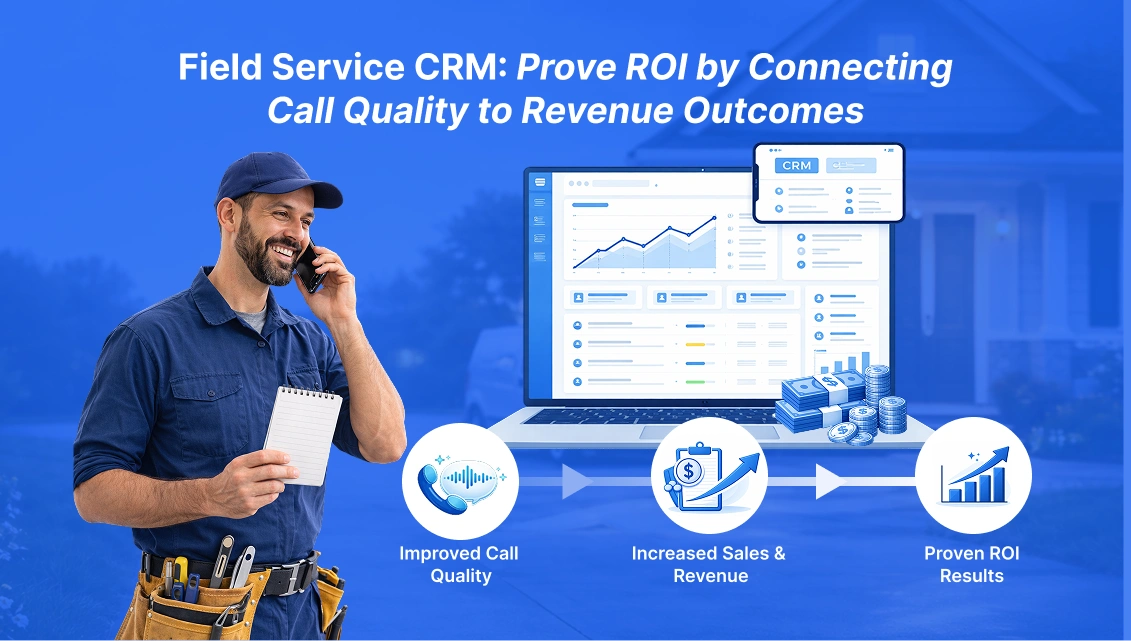
Most field service CRMs tell you what happened, not why.
The reality is simple.
Customer calls, not your CRM dashboard, determine whether you win or lose revenue.
If you cannot connect call quality to bookings, you cannot prove ROI.
The biggest gap in CRM for field service is the lack of visibility into customer conversations. CRMs track leads, jobs, and revenue, but they do not explain how call handling impacts conversions.
You see outcomes, but not the decisions that created them.
This information matters more than most teams realize. Research from Harvard Business Review shows that faster response times significantly improve lead conversion.
In field service, the first call often decides whether a job gets booked or lost. Many businesses still miss calls, delay responses, or fail to guide conversations effectively.
Insights from McKinsey & Company also show that customer interactions directly influence revenue. In service businesses, that interaction is usually a phone call, not a form submission or dashboard update.
Your CRM can show how many leads came in and how many jobs were completed. But it cannot show what happened inside the call, where the deal was lost, or why one agent converts better than another.
That is where revenue leakage happens.
To truly prove ROI from your CRM for field service, teams need to move beyond tracking activity and start understanding conversations. Platforms like Convin help connect call quality directly to revenue outcomes.
Know what drives revenue, starting with your calls.
You Have a CRM, But Can You Really Prove ROI?
Most businesses today rely on a CRM for field service to manage leads, jobs, and customer data. It gives you visibility into operations and revenue at a surface level.
But here is the problem.
Most teams track leads, jobs, and revenue. Yet they still struggle to answer one key question. What actually drove that revenue?
That is where the gap in most field service CRM software becomes clear.
The Blind Spot: Customer Calls
In field service businesses, revenue is driven by conversations. The first customer call often decides whether a job gets booked or lost.
But most CRM for field service platforms do not capture:
- What happened during the call
- How well the agent handled the conversation
- Why a lead converted or dropped off
This creates a major blind spot.
Why CRM ROI for Field Service Is Hard to Prove
Your CRM may show:
- Number of leads generated
- Jobs scheduled
- Revenue closed
But it does not show:
- Missed calls that could have turned into jobs
- Poor call handling that reduced conversions
- High-intent leads that were not followed up
Without this, CRM ROI for field service is incomplete.
The Real Issue
A typical field service CRM tracks activity. It does not explain performance.
You cannot:
- Accurately measure call-to-booking conversion
- Identify where revenue is leaking
- Improve team performance based on real interactions
What This Means for Your Business
If your CRM for field service cannot connect customer calls to revenue outcomes, you are only seeing part of the picture.
To truly prove ROI, you need visibility into the one place where decisions happen: customer conversations.
Track the calls that drive revenue and finally prove your CRM ROI.
Every Customer Call Is a Revenue Moment
In a CRM for field service, every incoming call is more than just a customer interaction. It is a direct revenue opportunity. The first call often decides whether a job gets booked or lost.
Customers typically reach out when they have an immediate need. How that call is handled determines the outcome. A quick response, clear communication, and confidence can turn that call into a confirmed booking.
But small mistakes can quickly lead to lost opportunities.
- Delayed response or missed call
- Poor explanation of pricing or services
- No clear next step or booking confirmation
These issues rarely show up inside a field service CRM. The system records the lead, but not the quality of the interaction.
This creates a gap.
Without visibility into customer conversations, teams rely on assumptions. They cannot identify what went wrong, which calls failed to convert, or how to improve performance. As a result, CRM ROI for field service remains unclear.
To improve conversions, businesses need to treat every call as a measurable revenue moment. When you connect call handling to booking outcomes, your CRM for field service becomes more than a tracking tool. It becomes a system that helps you consistently grow revenue.
Turn every customer call into a booked job and measurable revenue.
Where Do Most Field Service CRMs Fall Short?
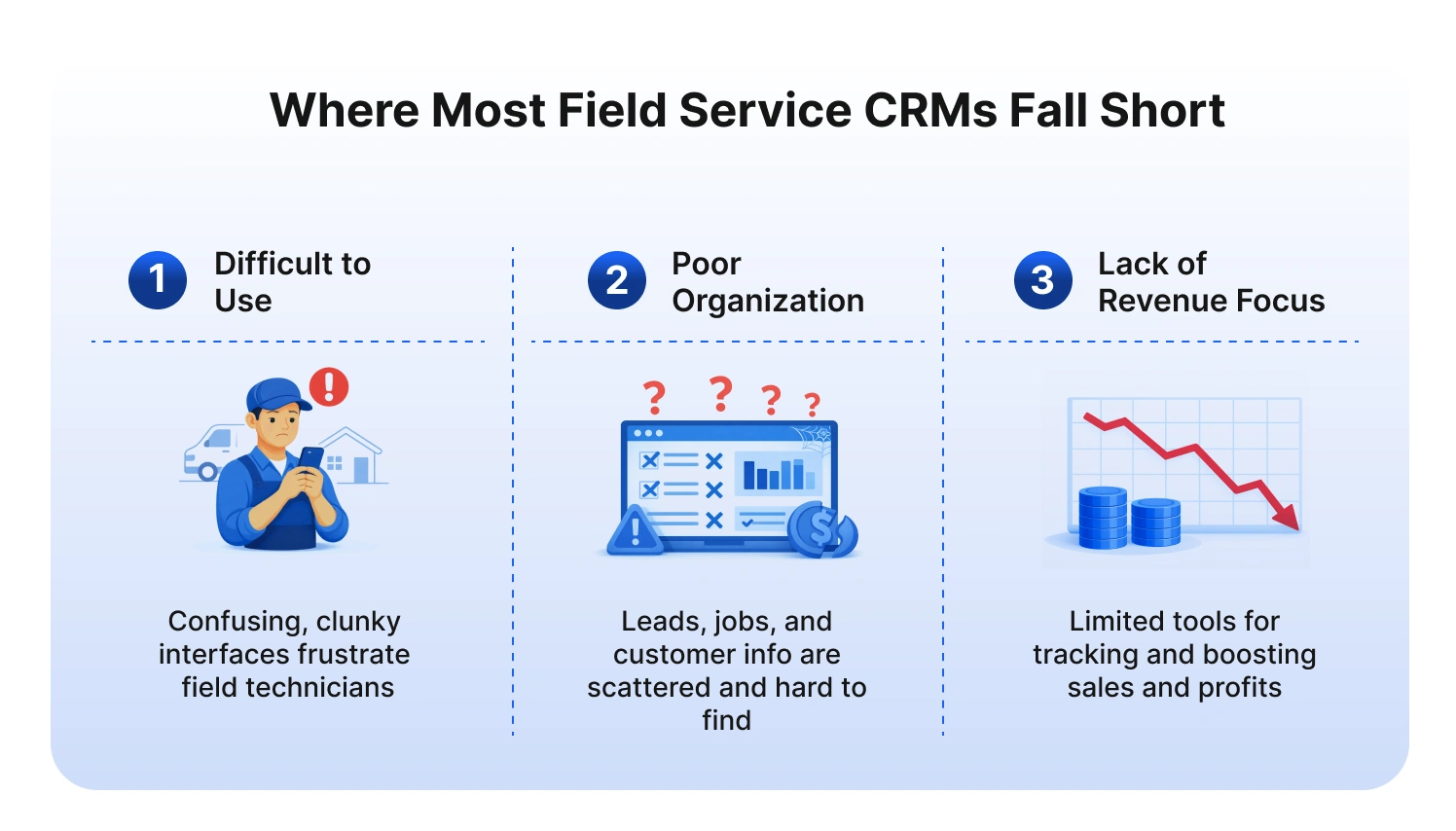
Most teams invest in a CRM for field service to bring structure to their operations. It helps you manage leads, schedule jobs, and keep customer data in one place.
And to be fair, it does that well. But when you try to understand performance, things start to get unclear.
The Real Gap
Your CRM shows you what happened. It does not tell you why it happened.
You can see:
- Leads coming in
- Jobs getting booked
- Revenue numbers going up or down
But you are left guessing:
- Why did some calls convert while others didn’t?
- Where are we losing high-intent customers?
- What are our best agents doing differently?
What You Don’t See
In field service, revenue decisions happen on calls.
But most field service CRM tools do not capture that layer.
So you have no visibility into:
- How well calls are handled
- Whether customers are getting clear answers
- What objections are stopping bookings
This is where things slip through the cracks.
Why This Becomes a Problem
When you cannot see what is happening inside conversations, improving performance becomes difficult.
Teams start relying on assumptions instead of data.
They tweak scripts, train agents, or increase marketing spend without knowing what actually needs fixing.
And that is why CRM ROI for field service often feels unclear.
A CRM for field service is great at tracking activity. But revenue is not driven by activity alone. It is driven by conversations.
If your CRM cannot show you what is happening in those conversations, it will always fall short when it comes to explaining and improving revenue.
Close the gap between data and decisions to start driving real revenue.
This blog is just the start.
Unlock the power of Convin’s AI with a live demo.

What a Revenue-Focused CRM for Field Service Should Actually Do
A modern CRM for field service should do more than track leads and schedule jobs. It should help you understand what drives revenue and how to improve it.
The goal is simple. Move from tracking activity to improving outcomes.
- It Should Connect Calls to Revenue
In field service, every booking starts with a conversation.
Your CRM should clearly show:
- Which calls turned into booked jobs
- Which leads did not convert, and why
- Call-to-booking conversion rates
This is how you start proving CRM ROI for field service.
- It Should Give Visibility Into Call Quality
A revenue-focused field service CRM should not ignore conversations.
It should help you understand:
- How agents handle customer calls
- Where conversations break down
- What top-performing calls look like
Without this, you cannot improve conversions consistently.
- It Should Highlight Missed Opportunities
Not every lost lead is bad. Some are missed opportunities.
Your CRM for field service should help identify:
- Missed or unanswered calls
- High-intent leads that did not convert
- Delayed responses that impacted bookings
This is where hidden revenue loss exists.
- It Should Enable Data-Driven Improvements
A strong field service CRM should not just store data. It should help you act on it.
That means:
- Identifying patterns in successful calls
- Improving scripts and responses
- Coaching teams based on real interactions
This is how performance improves over time.
- It Should Work With AI and Conversation Intelligence
To scale this effectively, your CRM for field service should integrate with tools like Convin.
This allows you to:
- Analyze every call automatically
- Score call quality at scale
- Connect conversations directly to revenue outcomes
A revenue-focused CRM for field service does not just tell you what happened. It helps you understand why it happened and how to improve it.
That is what turns a CRM from a tracking tool into a revenue-driving system.
Turn your CRM into a revenue-driving system.
How Convin Powers ROI-Driven CRM for Field Service
A field service CRM usually shows you leads, jobs, and money. But it doesn't show what really happens when customers talk to each other. Convin fills in this gap.
- It Brings Visibility Into Every Call
Convin adds a conversation intelligence layer on top of your field service CRM.
It helps you:
- Analyze every inbound and outbound call
- Understand what customers are asking
- See how agents respond in real scenarios
Now, your CRM for field service is no longer blind to conversations.
- It Connects Call Quality to Revenue
Convin links conversations directly to outcomes.
You can clearly see:
- Which calls led to bookings
- Which calls failed and why
- How call quality impacts conversion rates
This makes CRM ROI for field service measurable and actionable.
- It Identifies Missed Revenue Opportunities
Not all lost leads are low quality. Many are lost due to poor handling.
With Convin, you can identify:
- Missed or dropped calls
- High-intent conversations that did not convert
- Gaps in agent communication
This helps you recover hidden revenue.
- It Enables Data-Driven Coaching and Improvement
Instead of guessing, teams can now improve based on real insights.
Convin helps you:
- Spot patterns in high-performing calls
- Improve scripts and responses
- Coach agents using actual conversations
This leads to better performance across the board.
- It Works Seamlessly With Your Existing CRM
You do not need to replace your current system.
Convin integrates with your CRM for field service and enhances it by:
- Adding AI call analysis
- Providing conversation-level insights
- Connecting calls to booking and revenue data
Convin turns your CRM for field service into a complete revenue system.
It closes the gap between:
- Data and decisions
- Conversations and outcomes
- Activity and revenue
So you can finally understand what drives growth and improve it consistently.
Bridge the gap between calls and revenue with Convin.
How to Tie Call Quality Directly to Revenue
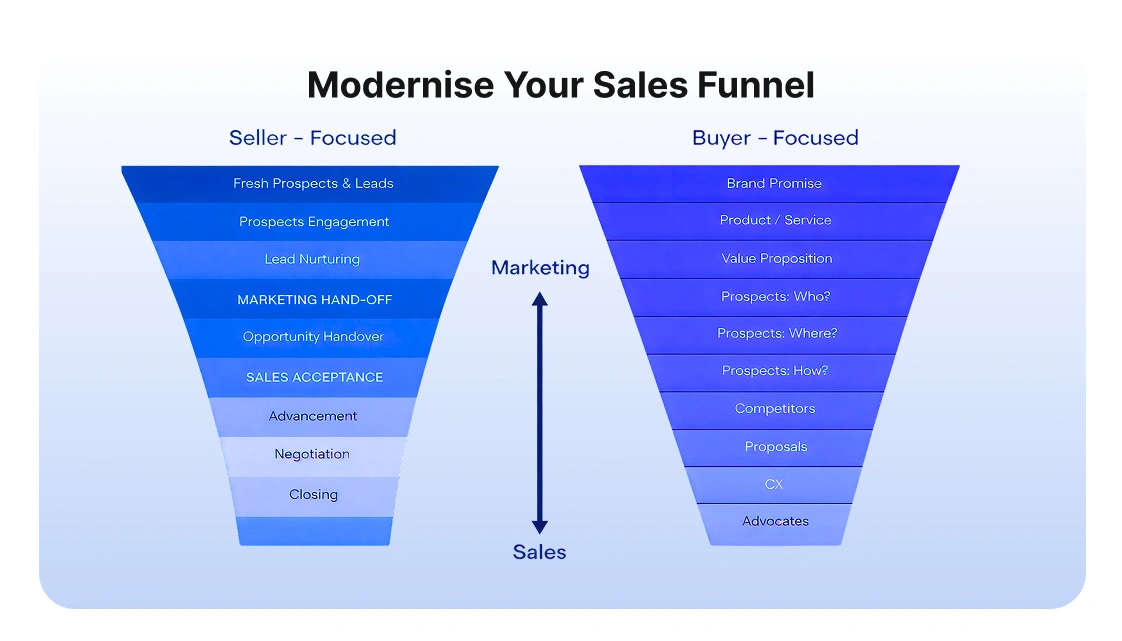
In a CRM for field service, revenue is often tracked at the end of the funnel. But the real drivers of that revenue sit at the very beginning. Customer calls.
To truly prove CRM ROI for field service, you need to connect what happens during calls to your revenue numbers.
- Start With Call-to-Booking Conversion
The first step is to measure how many calls actually turn into booked jobs.
Your field service CRM should help you track:
- Total inbound calls
- Calls answered vs missed
- Bookings generated from calls
This gives you a clear view of your conversion rate.
- Identify What High-Performing Calls Look Like
Not all calls are equal. Some convert consistently. Others do not.
You need visibility into:
- How top agents handle conversations
- What language drives customer confidence
- How objections are addressed
This is where call quality becomes directly linked to revenue outcomes.
- Spot Revenue Leakage Early
Many businesses lose revenue without realizing it.
Common gaps include:
- Missed or delayed calls
- Poor call handling
- No clear next step for the customer
Your CRM for field service alone cannot highlight these issues. You need conversation-level insights.
- Connect Conversations to Outcomes
To tie call quality to revenue, you must map:
- Calls → Bookings → Revenue
This means understanding:
- Which conversations led to successful jobs
- Which ones dropped off and why
- How improvements in call handling impact conversion rates
Convin makes this process scalable and actionable.
It helps you:
- Analyze every customer call using AI
- Score call quality based on real parameters
- Identify missed revenue opportunities
- Track call-to-booking conversion automatically
Most importantly, it connects conversation insights directly with your CRM for field service, so you can see how better calls lead to better revenue outcomes.
When you connect call quality to revenue:
- Conversion rates improve
- Missed opportunities reduce
- Team performance becomes measurable
This is how you move from tracking revenue to actually influencing it. And that is when your CRM for field service starts delivering real, provable ROI.
Turn call insights into measurable revenue with Convin.
Why More Field Service Teams Are Changing Their CRM
More field service businesses are rethinking their CRM for field service. Not because CRMs are failing, but because they are no longer enough to support how modern teams operate and grow.
The Shift From Operations to Revenue
Traditionally, field service CRM software was built for logistics. It helped teams schedule jobs, manage technicians, and track work orders.
But today, field service teams are expected to drive revenue, not just manage operations. This shift is pushing businesses to look beyond basic CRM capabilities and focus on systems that can directly impact growth.
Rising Customer Expectations
Customer expectations have changed. Speed and experience now play a major role in whether a job gets booked.
Customers expect faster responses, clear communication, and seamless booking experiences. A traditional CRM for field service is not designed to manage or improve these real-time interactions.
Lack of Connected Data and Visibility
Most field service teams still work with disconnected systems. The CRM stores lead and job data, while conversations happen on separate call systems.
This creates a gap. Teams do not have a unified view of the customer journey, which makes it difficult to understand performance and improve outcomes.
The Need to Prove ROI
CRM adoption is high, but proving ROI remains a challenge.
Teams can see revenue numbers, but they cannot clearly connect those numbers to specific actions or interactions. Without this clarity, CRM ROI for field service stays difficult to measure and improve.
The Rise of AI and Conversation Intelligence
Field service is becoming more data-driven and AI-powered. Businesses want systems that do more than store information.
They want tools that can analyze interactions, identify patterns, and help improve performance. Traditional CRMs for field service platforms are not built for this level of insight.
Field service teams are not just changing tools. They are changing expectations.
They want visibility into customer conversations, a clear connection between actions and revenue, and systems that help improve performance.
That is why the shift is happening. From a basic CRM for field service to a system that can actually drive and prove revenue.
Upgrade from tracking operations to driving real revenue outcomes.
The Bottom Line: CRM Alone Isn’t Enough
A CRM for field service is great at keeping things organized. It shows you your leads, your jobs, and your revenue.
But when you step back and ask, “What actually drove this revenue?” the answers are not always clear.
That is because revenue in field service is decided in conversations. A single call can turn into a booked job or a missed opportunity. And most CRMs simply do not capture what happens in those moments.
So while your CRM shows outcomes, it misses the why behind them. You cannot see which calls converted, where customers dropped off, or how your team handled real situations. That is why CRM ROI for field service often feels incomplete.
To actually improve performance, you need more than tracking. You need visibility into conversations, clarity on what is working, and the ability to fix what is not.
A tool like Convin is crucial in this situation. They help you connect call quality to real revenue outcomes, so your CRM becomes something you can act on, not just look at.
Want to see how this works in real scenarios? Book a demo with Convin.
FAQs
1. What is the best CRM for field service businesses?
The best CRM for field service is one that not only manages leads and jobs but also integrates call tracking and conversation insights to improve conversions and revenue.
2. How does CRM improve customer experience in field service?
A field service CRM improves customer experience by enabling faster response times, better scheduling, and more personalized communication across calls and touchpoints.
3. Can CRM for field service integrate with call tracking software?
Modern CRM for field service platforms can integrate with call tracking and conversation intelligence tools to connect customer calls with booking and revenue data.
4. How can small field service businesses measure CRM ROI?
Small businesses can measure CRM ROI for field service by tracking call-to-booking conversion rates, missed call impact, and how customer interactions influence revenue outcomes.


.avif)


.avif)